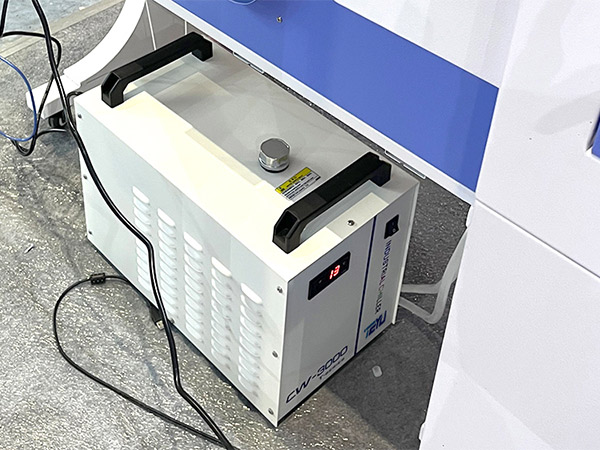
Small equipment can still have demanding cooling requirements. For OEMs developing compact laser systems, precision instruments, or specialized processing equipment, finding a chiller that fits limited space while maintaining stable temperature control is not always straightforward.
TEYU CWUP-05THSTY mini chiller is designed primarily for 3–5W UV laser systems. With a compact footprint of 39 × 27 × 23 cm, 460W cooling @ 20℃, and ±0.1°C temperature stability, it offers a practical cooling solution for desktop UV laser markers, compact engravers, and other precision equipment with compatible low cooling loads. Its PID temperature control helps maintain stable operating conditions without requiring a large industrial cooling system.

Where Can a Compact Precision Chiller Be Used?
UV laser marking and engraving remain the primary applications of the TEYU CWUP-05. However, similar cooling requirements can be found in other compact equipment.
For example, certain analytical instruments, laboratory systems, and specialized precision processing devices may require a small-capacity water chiller to manage heat while maintaining temperature stability. For equipment manufacturers and system integrators, TEYU CWUP-05 can be considered when the required cooling capacity, water flow, and temperature range are compatible.
Its compact size also makes it easier to accommodate in space-constrained equipment layouts, particularly for OEM systems where the cooling unit needs to fit within or alongside a machine enclosure.
Refrigerant Options for Different Market Requirements
Refrigerant selection is another consideration during equipment development. TEYU CWUP-05THSTY is available with R-134a, R-1234yf, or R-513A refrigerant options, depending on configuration.
R-134a remains a familiar and established option for applications where low-GWP refrigerant selection is not a primary consideration. R-513A provides another refrigerant choice, while R-1234yf, with a GWP of 4, may be relevant to manufacturers seeking lower-GWP cooling solutions.
For equipment intended for the EU market, refrigerant selection deserves particular attention in light of the F-gas Regulation's restrictions scheduled to apply from 2027 to certain stationary chillers with rated capacity up to and including 12 kW. The appropriate refrigerant configuration should be evaluated against the product's intended market and applicable requirements.
Designed for Convenient Equipment Integration
Beyond its compact footprint and temperature stability, TEYU CWUP-05 includes practical features for OEM applications:
1. Flexible power configurations: AC 1P 220–240V 50Hz and AC 1P 110V 60Hz.
2. RS-485 Modbus communication: Enables communication between the chiller and host equipment.
3. Built-in alarm protection: Water level, flow, and temperature alarms help identify cooling abnormalities.
4. Compact installation: A 39 × 27 × 23 cm footprint supports space-constrained system designs.
For manufacturers of desktop UV laser markers, compact engravers, and other precision equipment with low cooling loads, the TEYU CWUP-05THSTY offers a compact alternative to larger industrial chillers. Its suitability ultimately depends on the equipment's actual heat load, flow rate, and temperature requirements.