显示标签为“chiller maintenance”的博文。显示所有博文

2026年7月16日星期四

Why Does Your Industrial Chiller Keep Alarming in Summer?

Summer is one of the toughest seasons for industrial chillers. Higher ambient temperatures, increased production loads, dust buildup, and unstable power supplies can all make a chiller work harder than usual.

If your industrial chiller starts displaying frequent alarms during hot weather, don't assume it's a sign of equipment failure. In many cases, these alarms are built-in protection mechanisms that help prevent overheating and protect key refrigeration components.


Here are six common causes—and what you can do to reduce unnecessary alarms.

1. Make Sure the Chiller Has Enough Ventilation

Poor airflow is one of the most common reasons for summer overheating.

For most TEYU air-cooled chillers, the recommended installation clearance is:

* Low-power models: At least 1.5 m above the air outlet and 1 m around the air inlet.

* High-power models: At least 3.5 m above the air outlet and 1 m around the air inlet.

Adequate clearance prevents hot exhaust air from circulating back into the condenser, helping the chiller maintain stable cooling performance.

2. Check the Power Supply

Summer often brings heavier electrical loads, which can cause voltage fluctuations.

TEYU recommends keeping the supply voltage within ±5% of the rated input voltage. If power is unstable, using a properly sized voltage stabilizer can help prevent unnecessary alarms and improve compressor reliability.


3. Keep the Ambient Temperature Under Control

Even a properly functioning chiller has limits.

For most TEYU industrial chillers, the recommended ambient operating temperature is 20°C–30°C (68°F–86°F). If the surrounding temperature remains above 40°C (104°F), the chiller's high-temperature protection may be triggered.

Improving workshop ventilation or adding auxiliary cooling can help maintain stable operation during extreme heat.


4. Clean the Condenser Regularly

Dust buildup reduces airflow and heat dissipation, forcing the refrigeration system to work harder.

Clean the condenser and air filter regularly using compressed air. In dusty workshops, more frequent cleaning is recommended to maintain cooling efficiency and reduce energy consumption.


5. Replace Cooling Water Periodically

Over time, circulating cooling water can become contaminated, reducing heat transfer efficiency and increasing the risk of corrosion.

TEYU recommends replacing the cooling water approximately every three months, using distilled or purified water, and cleaning the water tank during water replacement.


6. Inspect the Water Filter

A clogged filter can restrict water flow and reduce cooling performance.

Regularly clean the filter screen and replace the filter element according to the manufacturer's maintenance recommendations to keep the cooling system operating efficiently.

An Alarm Doesn't Always Mean Something Is Broken


Many users assume a high-temperature alarm indicates equipment failure. In reality, industrial chillers are designed to protect themselves when operating conditions become unfavorable.

Simple maintenance, such as ensuring proper ventilation, cleaning the condenser, maintaining stable power, and replacing cooling water regularly, can significantly reduce summer alarms and improve long-term reliability.

If alarms continue after routine maintenance, it's best to contact the equipment manufacturer or service team for further troubleshooting.


Why this matters

Preventive maintenance takes far less time and cost than unexpected downtime. Spending a few minutes checking ventilation, water quality, and cleanliness can help your industrial chiller operate more reliably throughout the hottest months of the year.

Source: https://www.teyuchiller.com/why-does-your-industrial-chiller-keep-alarming-in-summer-6-maintenance-tips-to-reduce-downtime.html

2025年10月22日星期三

Industrial Chiller Water Maintenance Tips for Better Cooling Efficiency

In industrial cooling systems, water quality maintenance plays a vital role in ensuring stable and efficient operation. Clean cooling water not only extends the service life of equipment but also enhances productivity and reduces maintenance costs. As extended holidays approach, such as National Day, planning proper industrial chiller water maintenance becomes even more important to prevent downtime issues when production resumes.

Why Regular Water Replacement Matters

1. Protecting the Laser Source
For laser equipment, stable temperature control directly affects production quality. Poor water quality reduces heat transfer efficiency, causing the laser source to overheat, lose power, and even become damaged. Regularly replacing cooling water helps maintain proper flow and efficient heat dissipation, keeping the laser operating at peak performance.

2. Ensuring Accurate Flow Sensor Performance
Contaminated water often carries impurities and microorganisms that can accumulate on flow sensors, disrupting accurate readings and triggering system faults. Fresh, clean water keeps sensors sensitive and reliable, ensuring consistent chiller performance and effective temperature regulation.


Recommended Water Maintenance Before Long Holidays
1. Replace Cooling Water in Advance
If your equipment will be idle for 3–5 days, it's best to replace the cooling water beforehand. Fresh water minimizes bacterial growth, scale buildup, and pipe blockages. When replacing water, thoroughly clean the system's internal piping before refilling with new distilled or purified water.
2. Drain Water for Extended Shutdowns
If your system will be idle for more than a week, drain all water before shutdown. This prevents stagnant water from fostering microbial growth or clogging pipes. Make sure the entire system is fully emptied to maintain a clean internal environment.
3. Refill and Inspect After the Holiday
Once operations resume, check the cooling system for leaks and refill it with distilled or purified water to restore optimal operation.


Daily Water Quality Maintenance Tips
Keep the Cooling Circuit Clean: Regularly flush the system to remove scale, impurities, and biofilm. Replace cooling water approximately every three months to maintain system hygiene and efficiency.
Use the Right Type of Water: Always use distilled or purified water. Avoid tap water and mineral water, which can accelerate scaling and microbial growth.
Maintaining proper water quality is one of the simplest yet most effective ways to protect your industrial chiller and laser equipment. By following these guidelines, especially before and after long holidays, you can extend equipment lifespan, stabilize cooling performance, and ensure your production runs smoothly year-round.


2025年8月6日星期三

Spring and Summer Maintenance Guide for TEYU Water Chillers

As temperatures rise and spring transitions into summer, industrial environments become more challenging for cooling systems. At TEYU S&A, we recommend targeted seasonal maintenance to ensure your 


1. Maintain Adequate Clearance for Efficient Heat Dissipation

Proper clearance around the chiller is critical to maintaining effective airflow and preventing heat buildup. The requirements vary based on the industrial chiller’s power:

❆ Low-power chiller models: Ensure at least 1.5 meters of clearance above the top air outlet and 1 meter around the side air inlets.

❆ High-power chiller models: Provide at least 3.5 meters of clearance above and 1 meter at the sides to prevent hot air recirculation and performance degradation.

Always install the unit on a level surface with no obstruction to airflow. Avoid tight corners or confined spaces that restrict ventilation.


Spring and Summer Maintenance Guide for TEYU Water Chillers


2. Avoid Installing in Harsh Environments

Avoid Chillers should be kept away from areas with the following risks:

❆ Corrosive or flammable gases

❆ Heavy dust, oil mist, or conductive particles

❆ High humidity or extreme temperatures

❆ Strong magnetic fields

❆ Direct exposure to sunlight

These factors may severely affect performance or shorten the equipment's lifespan. Choose a stable environment that meets the chiller's ambient temperature and humidity requirements.


Spring and Summer Maintenance Guide for TEYU Water Chillers


3. Smart Placement: What to Do & What to Avoid

❆ Do place the chiller:

     On flat, stable ground

     In well-ventilated areas with sufficient space around all sides

❆ Don't:

     Suspend the chiller without support

     Place it near heat-generating equipment

     Install in unventilated attics, narrow rooms, or under direct sunlight

Proper positioning reduces thermal load, enhances cooling performance, and supports long-term reliability.


Spring and Summer Maintenance Guide for TEYU Water Chillers


3. Keep Air Filters & Condensers Clean

Spring often brings increased airborne particles such as dust and plant fibers. These can accumulate on filters and condenser fins, obstructing airflow and reducing cooling efficiency.

Clean Daily in Dusty Conditions: We recommend daily cleaning of the air filter and condenser during dusty seasons.

⚠ Use Caution: When cleaning with an air gun, keep the nozzle about 15 cm from the fins and blow perpendicularly to avoid damage.

Routine cleaning helps prevent over-temperature alarms and unplanned downtime, ensuring stable cooling throughout the season.


Spring and Summer Maintenance Guide for TEYU Water Chillers


Why Spring & Summer Maintenance Matters

A well-maintained TEYU water chiller not only ensures consistent cooling but also helps prevent unnecessary wear and energy loss. With smart placement, dust control, and environmental awareness, your equipment stays in optimal condition, supporting continuous productivity and extending service life.


Spring & Summer Reminder:

During spring and summer maintenance, prioritize tasks such as ensuring adequate ventilation, regularly cleaning air filters and condenser fins, monitoring ambient temperature, and checking water quality. These proactive steps help maintain stable chiller performance under warmer conditions. For additional support or technical guidance, feel free to contact our dedicated service team at service@teyuchiller.com.


Spring and Summer Maintenance Guide for TEYU Water Chillers


Source: https://www.teyuchiller.com/spring-and-summer-maintenance-guide-for-teyu-water-chillers.html

2025年3月28日星期五

How to Protect Your Laser Equipment from Dew in Spring Humidity

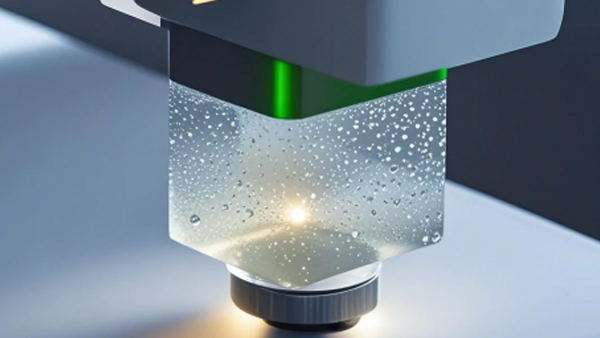
Spring humidity can be a threat to laser equipment. During the rainy season or in high-humidity workshops, condensation can form on laser equipment surfaces. This can lead to everything from system shutdowns to severe damage to core components. But don't worry—TEYU S&A Chiller is here to help you tackle the dew crisis with ease.

Dewing Crisis: The "Invisible Killer" for Lasers

1. What is Dewing?

When a laser system's surface temperature drops drastically due to traditional cooling methods, and the environmental humidity exceeds 60%, with the device temperature falling below the dew point, the water vapor in the air condenses into droplets on the equipment surface. It is similar to condensation forming on a cold soda bottle—this is the "dewing" phenomenon.


How to Protect Your Laser Equipment from Dew in Springs Humidity


2. How Dewing Affects Laser Equipment?

Optical lenses fog up, leading to scattered beams and reduced processing accuracy.

Moisture short-circuits the circuit boards, causing system crashes and even potential fires.

Metal components rust easily, increasing maintenance costs!

3. The 3 Major Issues with Traditional Humidity Control Solutions

Air Conditioner Dehumidification: High energy consumption, limited coverage.

Desiccant Absorption: Requires frequent replacement and struggles with continuous high humidity.

Equipment Shutdown for Insulation: While it alleviates dewing, it affects production efficiency and is only a temporary fix.


Laser Chiller: The "Key Weapon" Against Dewing

1. Proper Water Temperature Settings of Chillers

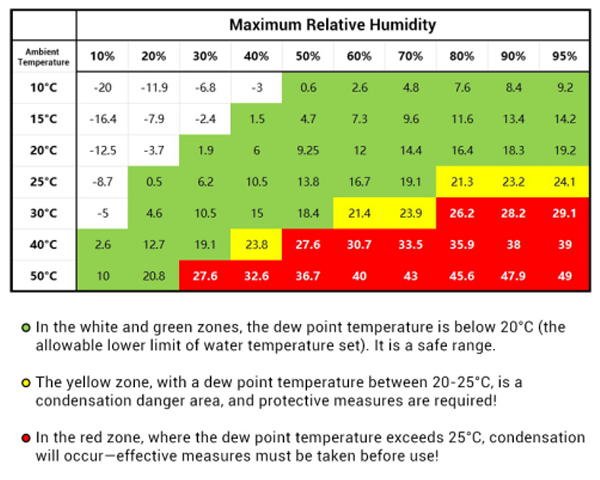
To effectively prevent dew formation, set the water temperature of the chiller above the dew point temperature, considering both the actual working environment's temperature and humidity. The dew point varies with ambient temperature and humidity (please refer to the chart below). This helps avoid significant temperature differences that could lead to condensation.


2. Proper Water Temperature of the Optics Circuit of the Chiller to Protect the Laser Head

If you're unsure how to adjust the water temperature through the chiller controller, feel free to contact our technical support team via service@teyuchiller.com. They will patiently provide you with professional guidance.


What to Do After Dewing?

1. Power down the equipment and use a dry cloth to wipe off the condensed water.

2. Use exhaust fans or dehumidifiers to reduce humidity.

3. Once the humidity drops, preheat the equipment for 30-40 minutes before restarting to prevent further condensation.

As spring humidity sets in, it's crucial to focus on moisture prevention and maintenance for your laser equipment. By ensuring stable operation, you can keep your production running smoothly.


How to Protect Your Laser Equipment from Dew in Springs Humidity


Source: https://www.teyuchiller.com/how-to-protect-your-laser-equipment-from-dew-in-spring-humidity

2025年2月8日星期六

How to Store Your Water Chiller Safely During Holiday Downtime

As the long holiday approaches, proper care for your water chiller is essential to keep it in top condition and ensure smooth operations when you’re back to work. Remember to drain the water before the holiday. Here’s a quick guide from TEYU Chiller Manufacturer to help you protect your equipment during the break.

1. Drain the Cooling Water

In winter, leaving cooling water inside the water chiller can lead to freezing and pipe damage when temperatures drop below 0℃. Stagnant water can also cause scaling, clogging pipes, and reducing the performance and lifespan of the chiller machine. Even antifreeze can thicken over time, potentially affecting the pump and triggering alarms.


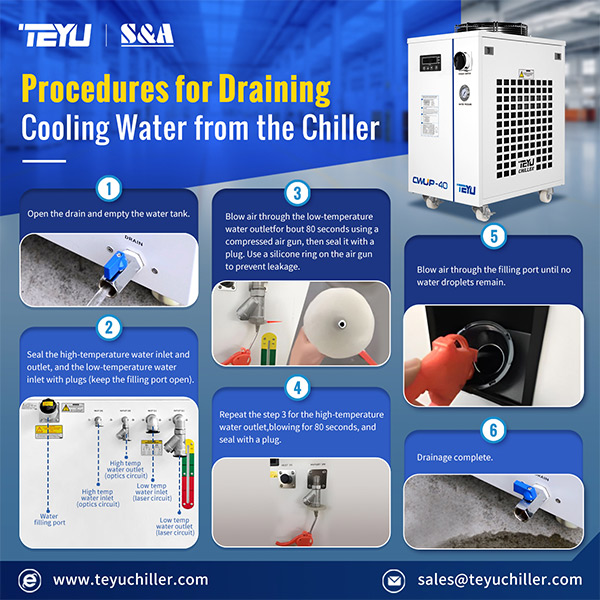
How to Drain Cooling Water:

① Open the drain and empty the water tank.

② Seal the high-temperature water inlet and outlet, as well as the low-temperature water inlet, with plugs (keep the filling port open).

③ Use a compressed air gun to blow through the low-temperature water outlet for approximately 80 seconds. After blowing, seal the outlet with a plug. It is recommended to attach a silicone ring to the front of the air gun to prevent air leakage during the process.

④ Repeat the process for the high-temperature water outlet, blowing for about 80 seconds, then seal it with a plug.

⑤ Blow air through the water-filling port until no water droplets remain.

⑥ Drainage finished.


How to Drain Cooling Water of an Industrial Chiller


Note:

1) When drying pipelines with an air gun, ensure the pressure does not exceed 0.6 MPa to prevent deformation of the Y-type filter screen.

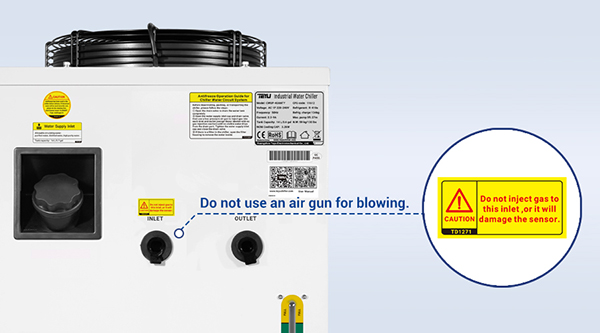
2) Avoid using an air gun on connectors marked with yellow labels located above or beside the water inlet and outlet to prevent damage.


How to Store Your Water Chiller Safely During Holiday Downtime-1


3) To minimize costs, collect antifreeze in a recovery container if it will be reused after the holiday period.


2. Store the Water Chiller

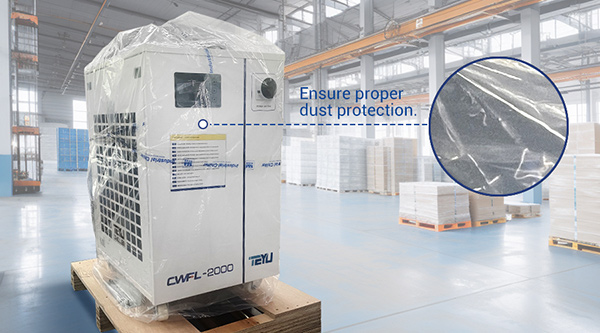
After cleaning and drying your chiller, store it in a safe, dry spot away from production areas. Cover it with a clean plastic or insulation bag to protect it from dust and moisture.


How to Store Your Water Chiller Safely During Holiday Downtime-2


Taking these precautions not only reduces the risk of equipment failure but ensures you’re ready to hit the ground running after the holidays.


TEYU Chiller Manufacturer: Your Trusted Industrial Water Chiller Expert

For over 23 years, TEYU has been a leader in industrial and laser chiller innovation, offering high-quality, reliable, and energy-efficient cooling solutions to industries worldwide. Whether you need guidance on chiller maintenance or a customized cooling system, TEYU is here to support your needs. Contact us today via sales@teyuchiller.com to learn more about our products and services.


TEYU Industrial Water Chiller Manufacturer and Supplier with 23 Years of Experience


Source: https://www.teyuchiller.com/how-to-store-your-water-chiller-safely-during-holiday-downtime

2024年2月29日星期四

How to Properly Restart a Laser Chiller After Long-Term Shutdown?

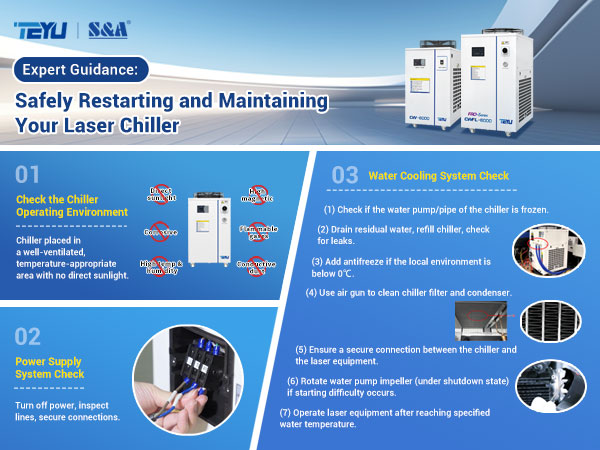
Do you know how to properly restart your laser chillers after a long-term shutdown? What checks should be performed after a long-term shutdown of your laser chillers? Here are some key tips summarized by TEYU S&A Chiller engineers for you:


1. Check the Operating Environment of the Chiller Machine

Check the laser chiller's operating environment for proper ventilation, suitable temperature, and no direct sunlight. Also, inspect for flammable or explosive materials in the vicinity to ensure safety.


2. Check the Power Supply System of the Chiller Machine

Before starting operations, ensure the main power supply for both the laser chiller and laser equipment is turned off. Check power supply lines for damage, ensure secure connections for power plugs and control signal lines, and verify reliable grounding.


3. Check the Water Cooling System of the Chiller Machine

(1)It is essential to check if the water pump/pipe of the chiller machine is frozen: Use a warm air device to blow the internal pipes of the chiller machine for at least 2 hours, confirming that the water system is not frozen. Short-circuit the chiller machine inlet and outlet pipes with a section of water pipe for a self-test, ensuring there is no ice in the external water pipes.

(2)Check the water level indicator; if residual water is found, drain it first. Then, fill the chiller with the specified amount of purified water/distilled water. Inspect the various water pipe connections, ensuring there are no signs of water leakage.

(3)If the local environment is below 0°C, proportionally add antifreeze to operate the laser chiller. After the weather warms up, replace it with pure water.

(4)Use an air gun to clean the chiller dustproof filter and the dust and impurities on the condenser surface.

(5)Ensure a secure connection between the laser chiller and the laser equipment interfaces. Turn on the chiller machine and check for any alarms. If alarms are detected, shut down the machine and address the alarm codes.

(6)If there is difficulty starting the water pump when the laser chiller is turned on, manually rotate the water pump motor impeller (please operate in the shutdown state).

(7)After starting the laser chiller and reaching the specified water temperature, the laser equipment can be operated (provided that the laser system is detected as normal).


*Reminder: If you have any questions or concerns about the above procedures for restarting the laser chiller, please feel free to contact our service team at service@teyuchiller.com. 


Maintenance Tips for Chiller Machines


Source: https://www.teyuchiller.com/how-to-properly-restart-a-laser-chiller-after-long-term-shutdown

2023年10月3日星期二

The Function And Maintenance Of Industrial Chiller Condenser

Water chiller is a necessary supporting cooling device for the use of industrial processing equipment, whose cooling capacity significantly affects the normal operation of the processing equipment. So, the normal functioning of industrial chiller is a must for the continuous operation of processing devices.


The role of condenser

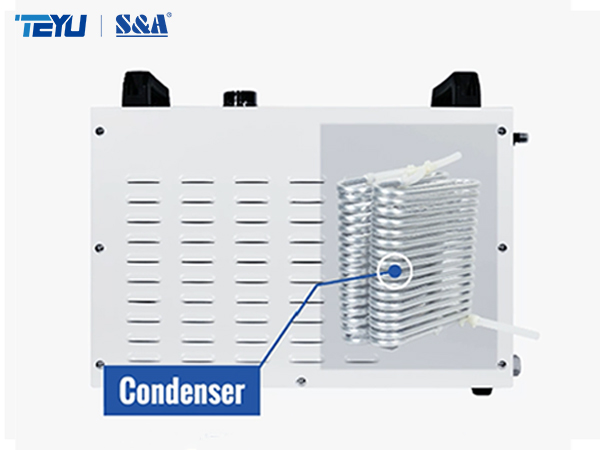
Condenser is an important component of water chiller. During the refrigeration process, the condenser outputs the heat absorbed in the evaporator and converted by the compressor. It is a necessary part of the heat dissipation of refrigerant, whose heat dissipation before refrigerant evaporation is performed by condenser and fan. In this sense, the decrease in condenser performance will directly affect the refrigeration capacity of the industrial chiller.


The Function And Maintenance Of Industrial Chiller Condenser


Condenser maintenance

Use an air gun to regularly clean the dust and impurities on the chiller condenser surface, so as to reduce the occurrence of poor heat dissipation caused by the increased temperature of the industrial chiller condenser.

*Note: Keep a safe distance (about 15cm(5.91in)) between the air outlet of the air gun and the cooling fin of the condenser; The air outlet of the air gun should blow to the condenser vertically.


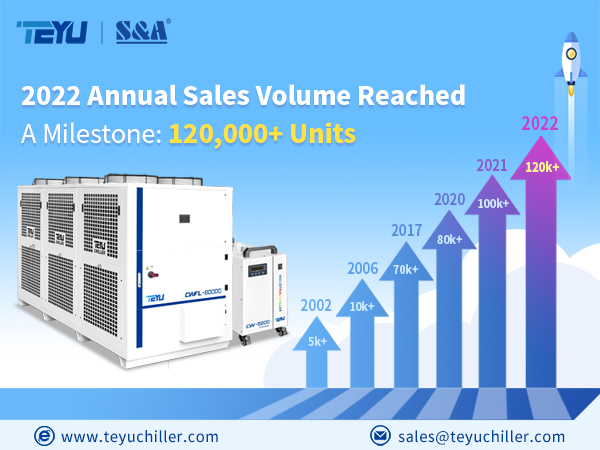
With 21-year dedication to the laser chiller industry, TEYU S&A Chiller provides premium and efficient industrial chillers with a 2-year warranty and quick service responses. With annual sales exceeding 120,000 units, TEYU S&A Chiller is a reliable partner for clients worldwide.


With 21-year dedication to the industrial chiller industry


Source: https://www.teyuchiller.com/function-and-maintenance-of-industrial-chiller-condenser

2021年10月17日星期日

Several tips on solving water blockage in laser water chiller

 Laser water chiller often goes with different kinds of laser systems which are commonly used in a wide variety of industries. However, in some industries, the working environment could be quite harsh and inferior. In this case, the laser chiller unit is easy to have the limescale. As it gradually accumulates, water blockage will occur in the water channel. Water blockage will affect the water flow so that the excessive heat from the laser system can not be taken away effectively. Therefore, the production efficiency will be greatly affected. So how to solve the water blockage in the laser water chiller?


First, check the location of the water blockage is in the external water circuit or the internal water circuit.

2.If the water blockage occurs in the internal water circuit, users can use the clean water to wash the pipeline first and then use the air gun to clear the water circuit. Later, add the clean distilled water, purified water or deionised water into the laser chiller unit. In daily use, it is suggested to change out the water on a regular basis and add some anti-scale agent to prevent limescale if necessary.

3.If the water blockage occurs in the external water circuit, users can check that circuit accordingly and remove the blockage easily.

Regular maintenance is quite helpful in keeping normal operation of the laser water chiller. If you have any other questions about laser chiller unit, you can e-mail to techsupport@teyu.com.cn or leave your message here.

S&A Teyu is a professional industrial chiller manufacturer based in China with 19 years of refrigeration experience. Its product range covers CO2 laser chiller, fiber laser chiller, UV laser chiller, ultrafast laser chiller, rack mount chiller, industrial process chiller and so on.


laser chiller unit


Buy Water Chillers at Factory Price! Get Live Quotes Now! 

https://www.teyuchiller.com/high-precision-uv-laser-water-chillers-cwul-05-with-long-life-cycle_p18.html


Guangzhou Teyu Electromechanical Co., Ltd.

SKYPE: teyuchiller

Email: marketing@teyu.com.cn

Website: https://www.teyuchiller.com

Tel: + 86-20-89301885

Fax: + 86-20-84309967


About S&A Brand

S&A(TEYU) was founded in 2002. After 19 years of development, the headquarter covers an area of 18,000 square meters, and has about 300 employees.  


Why choose S&A

Product Advantages:

1. With 11 patent certificates,CE, RoHS and REACH approval; Conforms to air transport requirements; 2 years warranty;

2.±0.1℃ high precision temperature control, stable cooling performance,support 

ModBus-485 communication;

3. Establish logistic warehouses at USA and Europe;

Manufacturing Advantages:

1.Independent R&D on sheet metal, evaporator, condenser and cores parts of chiller;

2. Annual output 8 0,000 units, product exports rate above 60%;

3. Standard bulk production, standard parts rate up to 80% ;

4. With excellent laboratory testing system, simulates actual working environment for 

chiller.


2021年9月26日星期日

The maintenance and energy saving tips of industrial water chiller unit

Industrial water chiller unit is normally categorized into air cooled chiller and water cooled chiller. It is a cooling device that provides constant temperature, constant flow and constant pressure. The temperature control range of different types of industrial water chillers is different. For S&A chiller, the temperature control range is 5-35 degree C. The basic working principle of the chiller is quite simple. First of all, adding certain amount of water into the chiller. Then the refrigeration system inside the chiller will cool down the water and then the cool water will be transferred by the water pump to the equipment to be cooled. Then the water will take away the heat from that equipment and flow back to the chiller to start another round of refrigeration and water circulation. To keep the optimal state of the industrial water chiller unit, certain kinds of maintenance and energy saving methods must be taken into account.


1.Use high quality water


The heat transfer process relies on the continuous water circulation. Therefore, water quality plays a key role in the running of the industrial water chiller. Quite a lot of users would use tap water as the circulating water and this is not suggested. Why? Well, tap water often contains certain amount of calcium bicarbonate and magnesium bicarbonate. These two kinds of chemicals can easily decompose and sedimentate in the water channel to form clogging, which will affect the heat exchange efficiency of the condenser and the evaporator, leading to rising electricity bill. The perfect water for the industrial water chiller unit can be purified water, clean distilled water or deionised water.

2.Change out the water on a regular basis


Even we use high quality water in the chiller, it is inevitable that some small particles may run into the water channel during the water circulation between the chiller and the equipment. Therefore, it is also very important to change out the water on a regular basis. Normally, we suggest users to do that every 3 months. But for some cases, for example the very dusty workplace, water changing should be more frequent. Therefore, the water changing frequency can depend on the chiller’s actual working environment.

3.Keep the chiller in well ventilated environment


Like many industrial equipment, industrial water chiller unit should be placed in well ventilated environment, so that it can dissipate its own heat normally. We all know overheating will shorten the service life of the chiller. By well ventilated environment, we refer to :
A.The room temperature should be below 40 degree C;
B.The air inlet and air outlet of the chiller should have certain distance with the obstacles. (The distance varies in different chiller models)

Hope the above maintenance and energy saving tips are helpful to you :)


industrial water chiller unit


Guangzhou Teyu Electromechanical Co., Ltd.

SKYPE: teyuchiller

Email: marketing@teyu.com.cn

Website: https://www.teyuchiller.com

Tel: + 86-20-89301885

Fax: + 86-20-84309967


About S&A Brand

S&A(TEYU) was founded in 2002. After 19 years of development, the headquarter covers an area of 18,000 square meters, and has about 300 employees.  


Why choose S&A

Product Advantages:

1. With 11 patent certificates,CE, RoHS and REACH approval; Conforms to air transport requirements; 2 years warranty;

2.±0.1℃ high precision temperature control, stable cooling performance,support 

ModBus-485 communication;

3. Establish logistic warehouses at USA and Europe;

Manufacturing Advantages:

1.Independent R&D on sheet metal, evaporator, condenser and cores parts of chiller;

2. Annual output 8 0,000 units, product exports rate above 60%;

3. Standard bulk production, standard parts rate up to 80% ;

4. With excellent laboratory testing system, simulates actual working environment for 

chiller.


2019年8月18日星期日

The Key to Avoid Condensed Water on Fiber Laser is S&A Recirculating Indoor Water Chiller

This summer seems to be much hotter than last summer. The ambient temperature in some places in Southeast Asia has already risen to nearly 40 degree celsius. In this kind of situation, the condensed water is likely to occur to the fiber lasersince the difference between the ambient temperature and the water temperature is too big. However, Mr. Giang from Vietnam doesn’t have this problem for the fiber laser of his fiber laser cutting machine, because he has S&A recirculating indoor water chiller CWFL-500.

Normally speaking, condensed water occurs when the temperature difference between ambient temperature and the water temperature is over 10 degree celsius and S&A recirculating indoor water chiller CWFL-500 solves this problem perfectly. Why? Well, S&A recirculating indoor water chiller CWFL-500 is designed with intelligent temperature controller which has constant & intelligent temperature control mode. Under intelligent temperature mode, the water temperature adjusts itself automatically according to the ambient temperature ( water temperature is generally 2 degree celsius lower than the ambient temperature) to avoid the generation of the condensed water. 

Through 17-year experience in laser refrigeration, S&A has always known what you need. 

For more detailed parameters of S&A recirculating indoor water chiller CWFL-500, click https://www.teyuchiller.com/dual-temperature-water-chillers-cwfl-500-for-500w-fiber-laser_p13.html

recirculating indoor water chiller

Buy Water Chillers at Factory Price, Get Live Quotes Now! 


Guangzhou Teyu Electromechanical Co., Ltd.
SKYPE: teyuchiller
Email: marketing@teyu.com.cn
Tel: + 86-20-89301885
Fax: + 86-20-84309967


About S&A Brand
S&A(TEYU) was founded in 2002. After 16 years of development, the headquarter covers an area of 18,000 square meters, and has about 250 employees.  

Why choose S&A
Product Advantages:
1. With 11 patent certificates,CE, RoHS and REACH approval; Conforms to air transport requirements; 2 years warranty;
2.±0.1℃ high precision temperature control, stable cooling performance,support 
ModBus-485 communication;
3. Establish logistic warehouses at USA and Europe;
Manufacturing Advantages:
1.Independent R&D on sheet metal, evaporator, condenser and cores parts of chiller;
2. Annual output 60,000 units, product exports rate above 60%;
3. Standard bulk production, standard parts rate up to 80% ;
4. With excellent laboratory testing system, simulates actual working environment for 
chiller.